Skip to content

Traditional Chinese folk toy

Zhuzhiliao

Spin it and it screams.

Zhuzhiliao (竹知了, literally “bamboo cicada”) is a folk toy from rural China: a hollow bamboo tube, a paper membrane, a rosin-coated string. Whirl it around a stick and it wails like a cicada in August. This site explains what it is, how the sound is made, and why hundreds of thousands of people suddenly started searching for it — and lets you spin a physically simulated one in your browser.

Free, no install, no account. Works offline once loaded.

Press and draw circles. Sound on.

What is a zhuzhiliao?

A zhuzhiliao is a Chinese children's toy with no recorded inventor and no fixed birth year — the kind of thing a grandfather cuts from a length of bamboo and hands to a grandchild. Across much of China it also goes by 竹蝉 (bamboo cicada) or 响蝉 (screaming cicada). For several generations it is simply the sound of summer.

The whole thing has three parts, and none of them are complicated:

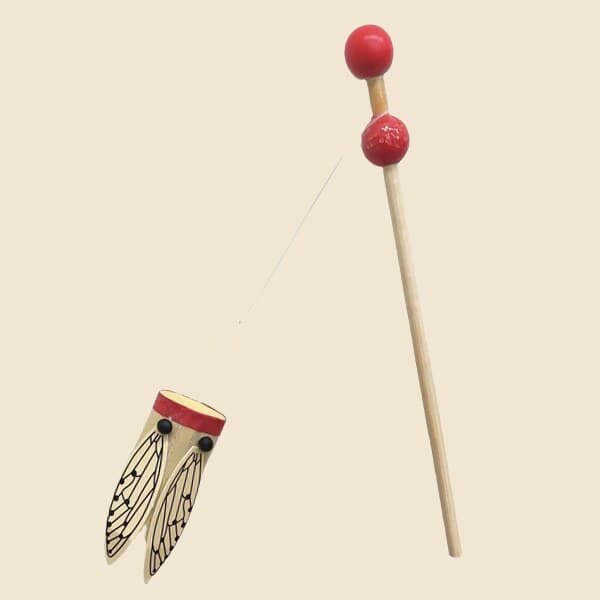
A zhuzhiliao toy: a short bamboo tube painted as a cicada, hanging on a thread from a slim wooden handle with two red beads
The whole toy — bamboo body, thread, and the rosined handle it hangs from.
A hollow bamboo tube
Open at one end, sealed with a taut membrane of kraft paper, thin card, or a shaved bamboo skin. This is the resonator.
A thin string
Cotton thread or fishing line, passed through the centre of the membrane and knotted inside the tube so it pulls on the membrane directly.
A rosin-coated stick
A short bamboo handle rubbed with rosin — the same rosin a violinist puts on a bow. This is where the sound is actually born.

Total cost of a handmade one in a Chinese market: under one yuan. Total number of moving parts: zero.

How zhuzhiliao makes its sound

It is a genuinely elegant piece of physics, and it is the same physics as a violin.

  1. Stick–slip friction

    As the tube whirls around the handle, the string drags across the rosin. Rosin is sticky under low speed and slippery under high speed, so the string alternately grabs and releases hundreds of times a second. That grab-and-release is the vibration source — not a rubbing hiss, but a train of sharp pulses.

  2. The membrane picks it up

    Those pulses travel along the string to the knot, and the knot yanks the paper membrane in and out. The membrane is far larger than the string, so it moves a lot more air.

  3. The tube amplifies it

    The hollow bamboo body is a resonating chamber. It reinforces a band of frequencies and turns a faint scratching into a loud, buzzing “waa — waa —”.

  4. Speed becomes pitch

    Spin faster and the pulse rate climbs, the tone rises, and the cry gets more urgent — which is exactly why it reads as a cicada rather than as a machine.

Two consequences you can test in five seconds: if the membrane is not drum-tight the sound goes dull and muffled, and if you pinch the string between two fingers while spinning, it goes silent instantly — you have damped the vibrating element.

How to play with a zhuzhiliao

Hold the handle in one hand and get the tube swinging in a circle around it, the way you would swing a skipping rope. Once the string is taut and the tube is orbiting, the cry starts on its own and holds as long as you keep the circle going.

  1. Keep the string taut

    A slack string cannot rub the rosin. If it goes quiet mid-spin, you have lost tension, not speed.

  2. Small circles, fast wrist

    It is a wrist movement, not an arm movement. Rate of rotation matters far more than the size of the circle.

  3. Re-rosin when it fades

    A handle that has lost its rosin will spin silently. Rub fresh rosin along the contact zone and it comes back.

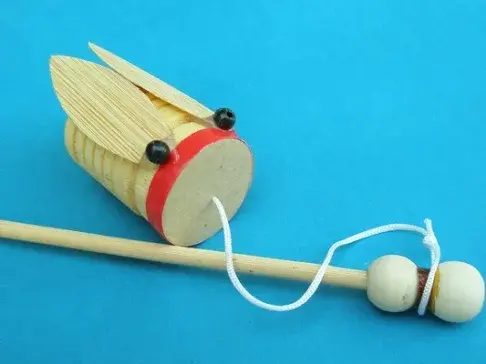
Close-up of a zhuzhiliao showing the red-banded bamboo tube, shaved bamboo wings, and the string knotted to the beaded handle
The membrane end, the string, and the beads that stop it slipping off the handle.

Other shapes of the same toy

The cicada is the best known, but the same mechanism gets sold as a frog (a lower, croaking “gua — gua —”), a big-mouthed fish, and a handful of other animals. Only the resonator shape changes; the rosin and the string are identical.

The browser version

Real ones are getting hard to find outside of village markets, so this project rebuilds the toy as a single HTML file you can spin with a finger. It is open source, has zero dependencies and zero build step — save the page and it still works twenty years from now, offline.

  • Recorded from a real toy

    The main voice is a 1.72-second sample cut from footage of an actual zhuzhiliao — exactly four “waa” cycles, loop-aligned at the envelope boundaries and cross-faded so it repeats seamlessly. Playback rate tracks how fast you are spinning.

  • Synthesis as a fallback

    If the sample fails to decode, the toy falls back to a full synthesis chain: a sawtooth oscillator standing in for stick–slip friction, low-frequency amplitude modulation for the cicada grain, and three parallel band-pass resonances for the membrane and tube.

  • Actual rope physics

    The tube is a point mass on a string — gravity, an elastic tether that pulls but never pushes, air drag, integrated at a fixed 1/240 s step. Below roughly 1.1 revolutions per second, or with a slack string, it simply refuses to sing.

  • Built for phones

    Press and draw circles with your thumb; on touch the anchor lifts above your fingertip so your hand does not cover the toy. There is an auto-spin button, and on a phone with motion access you can swing the handset itself.

  • An optional 3D layer

    A transparent WebGL layer sits over the 2D canvas with a procedurally modelled cicada — no external meshes or textures, proportions measured from a real toy. Physics, sound and input all stay in the 2D layer, so if WebGL is unavailable the page silently falls back to the hand-drawn version.

  • One file, no dependencies

    No framework, no bundler, no network call after first load. Audio initialises on your first tap, the static scene is pre-composited to an offscreen layer, and the audio thread suspends after eight idle seconds to save battery.

Frequently asked questions

What is a zhuzhiliao?

A zhuzhiliao (竹知了) is a traditional Chinese bamboo toy that imitates a cicada. A hollow bamboo tube is sealed with a taut paper membrane, a thin string runs through the membrane, and the string rubs against a rosin-coated handle when you whirl the tube in a circle. The friction vibrates the membrane and the tube amplifies it into a loud cicada-like cry.

Why is zhuzhiliao trending?

In late July 2026, a short video paired the toy with a catchphrase from a well-known Chinese product launch, because the toy's sound resembled a piece of audience audio from that event that was already a meme. A large number of such videos were then reported and taken down, which pushed the story onto trending lists and multiplied the imitations — a classic Streisand effect. Most of the search traffic comes from people trying to understand the reference.

How does a zhuzhiliao make sound?

Through stick–slip friction, the same mechanism as a violin bow. The rosin on the handle alternately grips and releases the string hundreds of times a second, sending pulses down the string to the paper membrane. The membrane vibrates and the hollow bamboo tube acts as a resonating chamber, amplifying it into the “waa — waa —” cry. Spinning faster raises the pitch.

Why does it stop making noise when I pinch the string?

Because the string is the vibrating element. Pinching it damps the oscillation before it can reach the membrane, so the sound cuts out instantly — and returns the moment you let go.

Is zhuzhiliao the same thing as a bamboo cicada?

Yes. 竹知了, 竹蝉 (bamboo cicada) and 响蝉 (screaming cicada) are regional names for the same toy. The frog and big-mouthed-fish versions use an identical rosin-and-string mechanism with a differently shaped resonator.

Can I play zhuzhiliao online for free?

Yes. The browser version is free, open source, needs no installation and no account. It runs from a single HTML file, so once the page has loaded it keeps working offline.

Does the online version work on a phone?

Yes, and it is designed phone-first. Press and draw circles with your thumb, or use the auto-spin button. On a phone that grants motion-sensor access over HTTPS you can also swing the handset itself to drive the toy.

Where can I buy a real zhuzhiliao?

Handmade ones are still sold on Chinese marketplaces for well under one yuan, usually listed as 竹知了, 竹蝉 or 响蝉. Outside China they are hard to find, which is part of why the browser version exists.
Spin it and it screams.

Spin one now